Planetary Gearbox Applications in Different Industries
Many industrial machines need a slow output speed and a strong turning force. They may also have limited space for the drive. A planetary gearbox can meet these needs when the correct model is selected.
Planetary gearboxes are used in machines that move materials, mix products and control movement. Their design shares the load across several planet gears. This helps them transmit high torque within a compact housing. Different models are built for different duties, so application checks are still needed.
This guide explains planetary gearbox applications across industries and the details buyers should review before choosing a unit.
What Is a Planetary Gearbox?
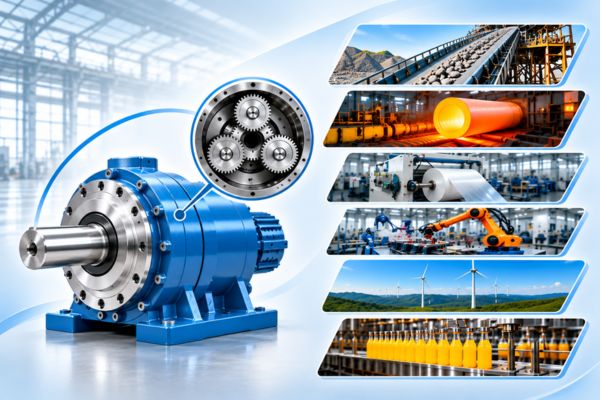
A planetary gearbox is a gear system built around a central sun gear, several planet gears, an outer ring gear and a planet carrier.
In a common reduction arrangement, the sun gear receives power, the ring gear stays fixed and the carrier provides the output. The planet gears turn while moving around the sun gear.
This arrangement reduces speed and increases output torque. The exact behaviour depends on which gearbox parts are driven, fixed and connected to the output.
Why Are Planetary Gearboxes Used in Industrial Machines?
Planetary gearboxes offer several features that can suit industrial equipment.
High Torque Within a Compact Space
Several planet gears share the transmitted load. This arrangement can provide a high torque capacity for the size of the gearbox.
That can help where a machine needs a strong drive but has limited installation space.
Reduced Output Speed
A planetary reducer lowers motor speed to suit the driven equipment. This can help match the drive to a conveyor, mixer or other machine.
Coaxial Shaft Arrangement
In a typical inline planetary gearbox, the input and output shafts share the same centre line. This can make the drive layout easier to fit into some machines.
Different Options for Different Duties
Industrial torque drives and precision motion drives do not always have the same features. A positioning application may need a low backlash model, while a process machine may place more focus on continuous torque.
Backlash means the small amount of movement between gear teeth before motion transfers when the direction changes. Buyers should specify any accuracy requirement instead of assuming every planetary gearbox offers the same precision.
Planetary Gearbox Applications at a Glance
Speedo Gear lists planetary gearbox applications across sectors such as steel, sugar, cement, textiles, chemicals, pharmaceuticals, paper and material handling. The table below shows the type of duty buyers should discuss for each application.
| Industry or Application | Typical Drive Need | Selection Focus |
|---|---|---|
| Steel plants | Drives for selected handling or process equipment | Peak loads, heat and operating cycle |
| Cement plants | Conveying, feeding and other selected duties | Dust, running hours and starting load |
| Sugar plants | Selected process and material movement drives | Required torque and production schedule |
| Chemical and pharmaceutical plants | Mixing and agitation | Fluid behaviour, shaft loads and site conditions |
| Material handling | Conveyors and lifting equipment | Starting torque, duty cycle and braking needs |
| Textile plants | Selected machine drives | Speed, load and maintenance access |
| Bottling equipment | Conveying and machine movement | Speed control and positioning needs |
| Paper plants | Selected process and handling drives | Moisture, load variation and operating hours |
| Construction machinery | Selected rotation and movement drives | Shock loads, mounting and outdoor exposure |
These are application groups, not proof that one gearbox model suits every machine within each industry.
Planetary Gearbox Applications in Steel Plants
Steel plants use equipment that moves and processes heavy materials. Some drive locations also face heat, dust and changing loads.
A planetary gearbox may be considered when a selected machine needs high torque in a compact drive arrangement. The complete duty must be reviewed, including short periods of heavy loading.
For steel plant applications, provide:
- Normal and maximum load.
- Frequency of starting and stopping.
- Any reversing duty.
- Nearby heat sources.
- Available mounting space.
- Required output speed.
The gearbox should be assessed for the actual drive function rather than the industry name alone.
Planetary Gearbox Applications in Cement Plants
Cement plants handle powders, raw materials and finished products. Some machines run for long periods, while others face loaded starts or uneven feed.
For a suitable planetary gearbox application, dust control and heat release deserve attention. A compact housing still needs the correct lubrication and cooling conditions.
Buyers should identify the exact machine, material handled and operating schedule. A gearbox used on a small feeder will have different needs from one used on a larger process drive.
Planetary Gearbox Applications in Sugar Plants
Sugar plants use many drives during production. A selected planetary drive may need to provide high torque while fitting within the machine layout.
Running hours and seasonal production schedules can affect selection. The gearbox must match the machine’s output speed and load throughout its operating cycle.
Large sugar mill drives are a specialist duty. Their requirements should not be assumed to fall within a general industrial gearbox range. Share the full application details before confirming suitability.
Planetary Gearboxes for Chemical and Pharmaceutical Mixers
Mixers and agitators turn material inside a vessel. The turning force needed can change with the mixture’s thickness, volume and process stage.
A liquid that flows easily may create a different load from a thick mixture. Starting after material has settled can also change the demand on the drive.
Useful selection details include:
- Vessel capacity.
- Material thickness, also called viscosity.
- Mixing blade design.
- Required mixing speed.
- Starting conditions.
- Loads acting along or across the shaft.
Where a site has special cleanliness, corrosion or hazardous area requirements, these must be stated separately. A standard gearbox should not be assumed to meet them.
Planetary Gearboxes for Conveyors and Material Handling
Conveyors move products or bulk materials between work areas. A planetary gearbox may suit a drive where installation space and torque requirements favour its design.
Selection should include the full load and the force needed to start the conveyor.
For lifting equipment, the gearbox must be reviewed as part of the complete machine. Braking, load holding and emergency stopping require their own design checks.
Buyers should provide the machine speed, maximum load, operating cycle and any requirement to stop or reverse frequently.
Planetary Gearbox Applications in Textile Plants
Textile machines carry out different tasks, so the drive requirement varies by machine section.
Some duties need a steady speed. Others involve changing loads or repeated starts. The gearbox should match the motor control system and the required output movement.
Also check how the unit will be serviced. A compact installation should still allow access to mounting bolts, seals and lubrication points.
Planetary Gearboxes for Bottling and Packaging Equipment
Bottling and packaging equipment may use drives for conveyors, feeding systems or controlled machine movements.
A general conveyor drive may mainly need the correct speed and torque. An indexing or positioning drive may also need low backlash and a suitable control response.
Precision planetary gearboxes are available for motion control applications, but this does not mean every industrial planetary unit is a precision model. State the required positioning accuracy during selection.
Planetary Gearbox Applications in Paper Plants
Paper plants include material movement and process equipment with different drive needs. Depending on the location, a gearbox may face moisture, long running hours or changing loads.
Buyers should explain whether the load is steady, whether the machine reverses and whether wash water or process moisture can reach the gearbox.
The supplier can then review the mounting, sealing and lubrication arrangement for that location.
Planetary Gearboxes for Construction Machinery
Construction machinery may need compact drives that operate under changing loads. Outdoor conditions can add dust, rain and temperature changes.
For a suitable planetary drive, confirm how the machine starts, stops and handles impacts. The mounting arrangement and any extra shaft loads also need review.
A gearbox should be chosen for the specific machine movement. A unit suitable for one rotation duty may not suit another with heavier impacts or a different operating cycle.
How to Select a Planetary Gearbox for Your Industry
Begin with the machine’s output requirements. Then check how the motor, gearbox and driven equipment will work together.
Calculate the Required Output Speed
For a reduction gearbox:
Output speed = Motor input speed ÷ Gearbox ratio
For example:
1,440 RPM ÷ 20 = 72 RPM
The theoretical output speed is 72 RPM with a 20:1 reduction ratio. Actual operating speed follows the actual motor speed.
Check Torque and Load Changes
The gearbox must carry the normal working torque and any permitted peak loads.
Tell the supplier about:
- Loaded starts.
- Thick or settling mixtures.
- Repeated reversing.
- Sudden impacts.
- Frequent stops and starts.
The same motor can create very different gearbox demands in different machines.
Review Operating Hours and Heat
A machine running for a short cycle has a different heat pattern from one operating continuously.
Share daily working hours, cycle times, room temperature and available airflow. The supplier should review the thermal limits for the chosen unit.
Confirm Mounting and Shaft Loads
Foot mounting and flange mounting require different installation details. Vertical and horizontal arrangements can also affect lubrication.
For mixers, pulleys, sprockets and similar equipment, confirm any additional loads on the output shaft. Do not assume the gearbox bearings can carry every external load.
What Planetary Gearbox Range Does Speedo Gear List?
Speedo Gear’s product page lists the following details:
| Product Detail | Listed Information |
|---|---|
| Housing material | Cast iron |
| Power range | 0.37 kW to 50 kW |
| Reduction ratio range | 7:1 to 400:1 |
| Mounting options | Foot and flange |
| Orientation options | Horizontal and vertical |
The exact model, ratio and mounting combination should be confirmed for the application. These listed ranges do not mean every combination is available or suitable for every duty.
Planetary Gearbox Maintenance Checklist
Use the instructions supplied for the exact model. A routine inspection can include:
- Check the oil level using the approved procedure.
- Look for leaks near seals and housing joints.
- Record unusual changes in temperature.
- Listen for changes in operating noise.
- Check vibration and mounting condition.
- Keep cooling areas clean.
- Inspect couplings and alignment.
- Follow the specified lubricant and oil change schedule.
Investigate a new noise or rising temperature instead of waiting for the next planned shutdown.
Planetary Gearbox Buying Mistakes to Avoid
Choosing Only by Ratio
The right ratio gives the desired speed, but the gearbox must also meet torque, heat and bearing requirements.
Assuming Every Model Offers Precision Positioning
Low backlash performance is model specific. Confirm it in the technical data when the application needs accurate positioning.
Ignoring the Mixture in an Agitator
Vessel size alone does not define the load. Material thickness, blade design and starting conditions also matter.
Treating Every Mounting Position as Interchangeable
A change in mounting position may require a different lubrication arrangement. Confirm it before installation.
Discuss Your Planetary Gearbox Requirement With Speedo Gear
For a planetary gearbox enquiry in Ahmedabad, Gujarat or elsewhere in India, prepare your machine details before contacting the supplier.
Share the motor power, input speed, required output speed, load, working hours and mounting position. Existing drawings and nameplate photos can also help.
Visit the planetary gearbox product page to review the listed range and submit your application requirements.
FAQs
Planetary gearboxes are used in selected applications across material handling, steel, cement, sugar, chemicals, pharmaceuticals, textiles, paper and other industries. Suitability depends on the gearbox model and machine duty.
Its gears are arranged around a central sun gear. Several planet gears share the load, helping the design transmit high torque within a relatively compact housing.
Yes, a suitable model can be used for mixing or agitation. Selection must consider mixing speed, material thickness, starting load and external shaft loads.
Divide the actual input speed by the reduction ratio. An input speed of 1,440 RPM with a 20:1 ratio gives a theoretical output speed of 72 RPM.
No. Motor compatibility, mounting, speed limits, backlash and operating duty must be checked for the selected model.
The better choice depends on the machine. Compare required torque, shaft layout, space, duty cycle, accuracy and maintenance needs before selecting either design.
Provide motor power, input speed, required output speed, load or torque, operating hours, mounting position and working conditions.