Key Factors to Check Before Choosing a Vertical Gear Drive for Mixing Applications
Agitators and mixers are widely used in chemical, pharmaceutical, food processing, water treatment, paint, textile and other process industries. These machines often require low or controlled operating speed with enough torque to move liquids, powders, slurries or other materials.
A Vertical Helical Gear Motor is a practical drive solution for many such applications because the gearbox can reduce motor speed while transmitting torque to a vertically arranged mixing shaft. Speedo Gear offers vertical and flange-mounted helical gearboxes intended for agitators, mixers, cranes and other industrial applications. Its current range includes 0.5 HP to 5 HP power options, output speeds of about 32–400 RPM and ratios from 3.8:1 to 44:1.
Selecting the right unit, however, requires more than matching motor horsepower. Buyers should consider mixer speed, required torque, load characteristics, mounting arrangement and working conditions.
Start With the Required Agitator or Mixer Speed
The first question should be: How fast does the mixing shaft need to rotate?
An agitator processing a low-viscosity liquid may require a different operating speed from a mixer handling thick slurry or heavy material.
The gearbox reduces the speed produced by the electric motor to the speed required at the mixing shaft. A simple relationship is:
Output RPM = Input RPM ÷ Gear Ratio
For example, if a motor operates at 1,440 RPM and the selected ratio is 20:1, the theoretical gearbox output would be approximately 72 RPM.
Speedo Gear lists input speed options of 960 RPM, 1,440 RPM and 2,800 RPM for its vertical helical gearbox range.
This makes the required output RPM an important starting point before selecting the gear ratio.
Calculate the Torque Requirement
Speed alone does not determine the correct gearbox.
The Vertical Helical Gear Motor must also produce enough torque to rotate the agitator or mixer under actual operating load.
Torque requirements can change according to:
- Material viscosity
- Tank capacity
- Impeller diameter
- Number of blades
- Mixing speed
- Material density
- Starting load
- Continuous operating load
- Mixing cycle duration
A mixer handling water, for example, will normally create a very different load compared with equipment handling thick paste.
Selecting a gearbox without considering torque can result in an undersized drive, overheating, excessive wear or poor mixing performance.
Select the Correct Gear Ratio
The gear ratio controls how much the motor speed is reduced.
A lower ratio generally gives a higher output speed, while a higher reduction ratio gives a lower output speed and, within equipment limits, greater torque multiplication.
Speedo Gear currently provides reduction ratios from approximately 3.8:1 to 44:1 for its vertical helical gear motor range.
Buyers should therefore determine the desired mixer RPM first and then select a suitable ratio based on motor speed.
For example:
| Motor Speed | Gear Ratio | Approx. Theoretical Output |
|---|---|---|
| 1440 RPM | 10:1 | 144 RPM |
| 1440 RPM | 20:1 | 72 RPM |
| 1440 RPM | 30:1 | 48 RPM |
| 960 RPM | 20:1 | 48 RPM |
Actual gearbox selection should still be confirmed against available models, loads and operating conditions.
Match Motor Power With the Mixing Load
A larger motor is not automatically a better choice.
Too little motor power may prevent the mixer from reaching the required operating condition. Oversizing can increase cost and may also lead to an unnecessarily large drive system.
Speedo Gear lists a 0.5 HP to 5 HP range for this vertical helical gearbox series.
The correct motor power should be selected according to the material, required torque, mixing speed and operating hours.
For difficult materials or heavy starting loads, buyers should provide complete process information rather than selecting only from HP and RPM.
Why Vertical Mounting Matters for Agitators
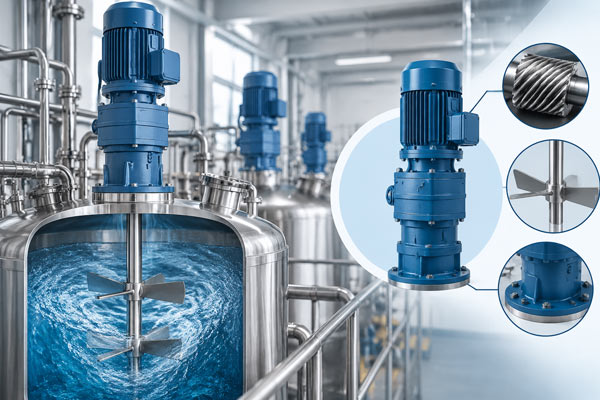
Many agitators are installed directly above a tank or vessel with the mixing shaft extending vertically downward.
A vertical gearbox configuration makes the drive arrangement easier to integrate with this type of machine layout.
Speedo Gear’s product is available in vertical or flange-mounted arrangements, including gearbox-side and motor-side flange configurations.
Before ordering, check shaft position, flange dimensions, mounting holes, available installation space and the relationship between the gearbox and mixing shaft.
Poor mounting compatibility may require additional fabrication or modification during installation.
Consider Continuous Duty and Starting Load
Agitators may operate continuously for several hours, while mixers may stop and start repeatedly during batch processing.
These two working patterns can place different demands on the gearbox.
A continuous-duty mixer requires reliable lubrication and heat management. A machine frequently starting with a full tank may experience a high initial load.
When requesting a gearbox, explain whether the machine:
operates continuously, runs only during batches, starts under load, experiences sudden load variation, or operates for long hours each day.
Check the Material Being Mixed
The material inside the tank has a major influence on drive selection.
Low-viscosity liquids may be comparatively easy to circulate. Thick chemicals, adhesives, slurries or concentrated mixtures can require much higher torque.
The drive should also be selected with the actual process condition in mind. Changes in viscosity during heating, cooling or chemical reaction can alter the load experienced by the agitator.
Providing the material characteristics to the supplier can therefore improve gearbox selection accuracy.
Check Shaft and Coupling Requirements
The gearbox output must connect properly with the agitator shaft.
Buyers should confirm shaft diameter, keyway, coupling type, output orientation and any external load acting on the shaft.
This becomes especially important for long vertical agitator shafts because the complete drive arrangement must remain aligned and mechanically stable.
Incorrect alignment can increase vibration and place unnecessary stress on bearings, couplings and gearbox components.
Review Operating Environment
Industrial mixing systems may operate around moisture, chemicals, dust or high temperatures.
When selecting the gearbox, inform the supplier about the installation environment.
A gearbox operating indoors in a clean production area may have different requirements from one mounted around chemical tanks or exposed industrial equipment.
The surrounding conditions can affect sealing, lubrication, maintenance planning and expected service life.
What Details Should Buyers Provide Before Ordering?
To receive a more accurate recommendation from a Vertical Helical Gear Motor Manufacturer in India, provide motor HP, motor RPM, required mixer RPM, expected torque or load, material being mixed, viscosity if available, operating hours, tank size, shaft arrangement, mounting position, flange dimensions and machine drawings.
Speedo Gear’s range uses a two-stage helical gearing arrangement and includes models SP102, SP128, SP142, SP160 and SP162. Model selection depends on parameters such as power, ratio, output speed, shaft size and application requirements.
Choosing a Vertical Helical Gear Motor Manufacturer
For agitator and mixer applications, buyers should select the gearbox according to the complete process requirement rather than focusing only on price.
Speedo Gear Pvt. Ltd. manufactures vertical and flange-mounted helical gear motors in Ahmedabad, Gujarat. The company lists its units for agitators, mixers, cranes and other industrial applications.
For buyers searching for a Vertical Helical Gear Motor Manufacturer in Ahmedabad, sharing detailed operating information can help identify a suitable model and reduction ratio.
Conclusion
Selecting the right Vertical Helical Gear Motor for agitators and mixers requires careful evaluation of output RPM, torque, gear ratio, motor power, material characteristics, mounting arrangement and operating duty.
A gearbox should match how the mixer actually works, not simply the motor horsepower.
Correct selection helps provide controlled mixing speed, reliable torque transmission and stable operation while reducing the risk of unnecessary mechanical stress or drive-related downtime.
Buyer Intent FAQs
A vertical or flange-mounted helical gear motor can be suitable where the agitator shaft requires a vertical drive arrangement and controlled output speed.
Start with the motor input RPM and required agitator output RPM. Divide input speed by desired output speed to estimate the required reduction ratio.
Speedo Gear currently lists approximately 0.5 HP to 5 HP for this product range.
The published range is approximately 32 RPM to 400 RPM, depending on motor speed, gearbox ratio and selected model.
Yes. Speedo Gear lists both vertical and flange-mounted configurations for this product.
Provide motor power, input RPM, desired output RPM, load or torque, mixing material, operating hours, mounting arrangement, shaft dimensions and available drawings.
Speedo Gear Pvt. Ltd. manufactures vertical helical gear motors and gearboxes in Ahmedabad, Gujarat for agitators, mixers and other industrial applications.